
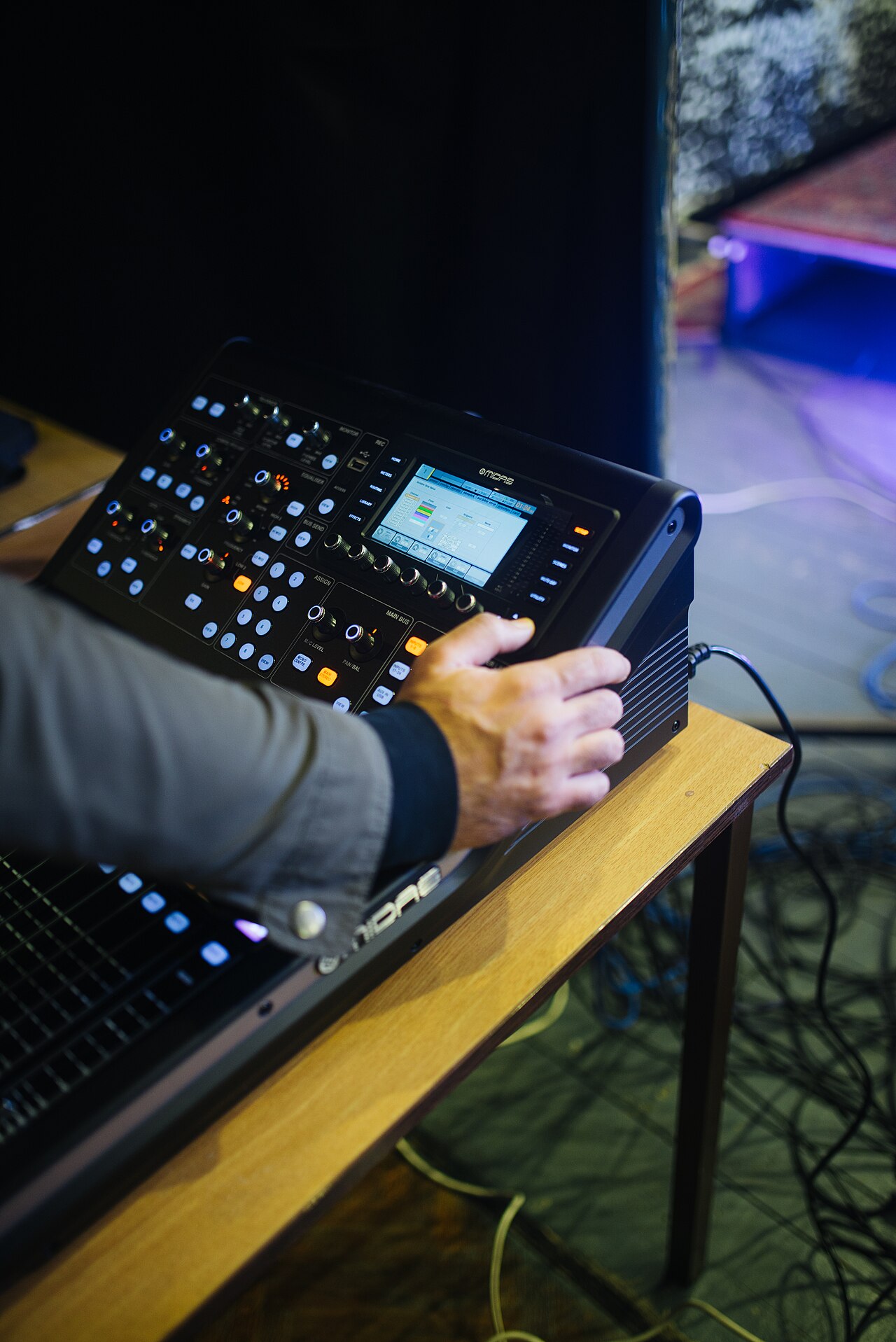
The Sound Guy at the Gig: Hard-Won Wisdom from Behind the Board
Yeah, I'm the guy who sees everything, hears everything, and usually knows why your band sounds like a bag of dying cats tonight. Let's talk about what you can do to make your next gig sound great.
Yeah, I'm the guy who sees everything, hears everything, and usually knows why your band sounds like a bag of dying cats tonight. I've mixed a thousand shows, from dive bars to proper venues, and ninety percent of the problems I hear start right there on stage. You want to sound better? Great. Here's some no-bullshit advice from someone who actually wants you to sound good, because frankly, it makes my night easier too.
Your Mic is Not a Beer Holder (Or a Megaphone)
Let's start with vocals, because that's where most bands fall apart. That Shure SM58 in your hand? It's a precision instrument, not a prop. Stop cupping the mic. Seriously, just stop. When you wrap your hand around the grille, you kill its ability to reject feedback, you make it sound boxy, and you turn a decent microphone into a cheap toy. It's not cool; it's just bad sound. Hold it an inch or two from your mouth, pointed directly at your lips, and keep that distance consistent. If you're going to pull away for an effect, know how to project without feedback. If you sing like you're talking into a megaphone from across the stage, I can't do anything for you. The microphone needs your help to do its job, and its job is to pick up *your voice*, not the drum kit.
Asking for Monitors Like a Grown-Up
It's not rocket science, but the way some of you ask for monitors, you'd think I was a mind reader. Don't just point at your wedge and shout, "More me!" That tells me nothing. Be specific, be polite, and be brief. "Can I get a little more vocal in my wedge, and maybe just a touch of kick drum?" That's gold. Even better: "I need more vocal and snare in my monitor mix, please." We work on additive mixes first, meaning we add what you need. Don't ask me to kill everything else so you can hear one thing. And please, listen for *your* sound first, then the critical elements you play with. If you're the singer, your vocal needs to be king. If you're the bassist, you need to hear kick and drums, and a bit of your own bass. Prioritize. And for the love of all that is holy, give me a minute to adjust before shouting again. It takes a second for the sound to travel and for me to tweak it.
The Humble DI: Your Unsung Hero
If you're playing acoustic guitar, bass, or keys, a good Direct Injection (DI) box is your best friend. Seriously, invest in one. I've seen more bands try to mic an acoustic guitar with a vocal mic and wonder why it sounds like a kazoo in a tin can. A quality DI, like a Radial JDI for passive or a J48 for active, takes your instrument's high-impedance, unbalanced signal and converts it into a low-impedance, balanced signal that my board can work with without hum, buzz, or signal loss. It's not just about getting a signal; it's about getting a *clean* signal. Your DI isn't fighting your amp; it's making sure your amp's *signal* gets to my board cleanly so I can make it sound good out front. If you've got a killer bass tone on stage, I want to capture that for the house, not a noisy mess.
Gain Structure Starts *With You*
This is fundamental, and it starts long before your signal hits my board. I can't polish a turd, and if you're sending me a distorted, clipped signal from your guitar pedal or your bass amp's DI out, that's what I'm going to get. Learn how to set the gain on your instruments, your pedals, and any preamps you're using. If you're seeing red lights on your gear, you're clipping, and that sound is now baked into the signal I receive. Keep your input levels clean and strong, but not distorted. Let *my* board do the heavy lifting for overall volume. This also goes for any backing tracks or click tracks you're sending. Make sure they're at a healthy, consistent level. A clean signal at the source means a clean mix for everyone.
Look, we're all on the same team. My job is to make you sound as good as humanly possible, given the room, the gear, and what you send me. Your job is to give me the best possible raw material to work with and to communicate effectively. A little knowledge about these basics will elevate your band's sound faster than any new pedal or overpriced instrument. Get your stage presence, your communication, and your signal chain dialed in, and you'll not only sound professional, but you'll make friends with every sound guy you meet. Trust me, that goes a long way.
